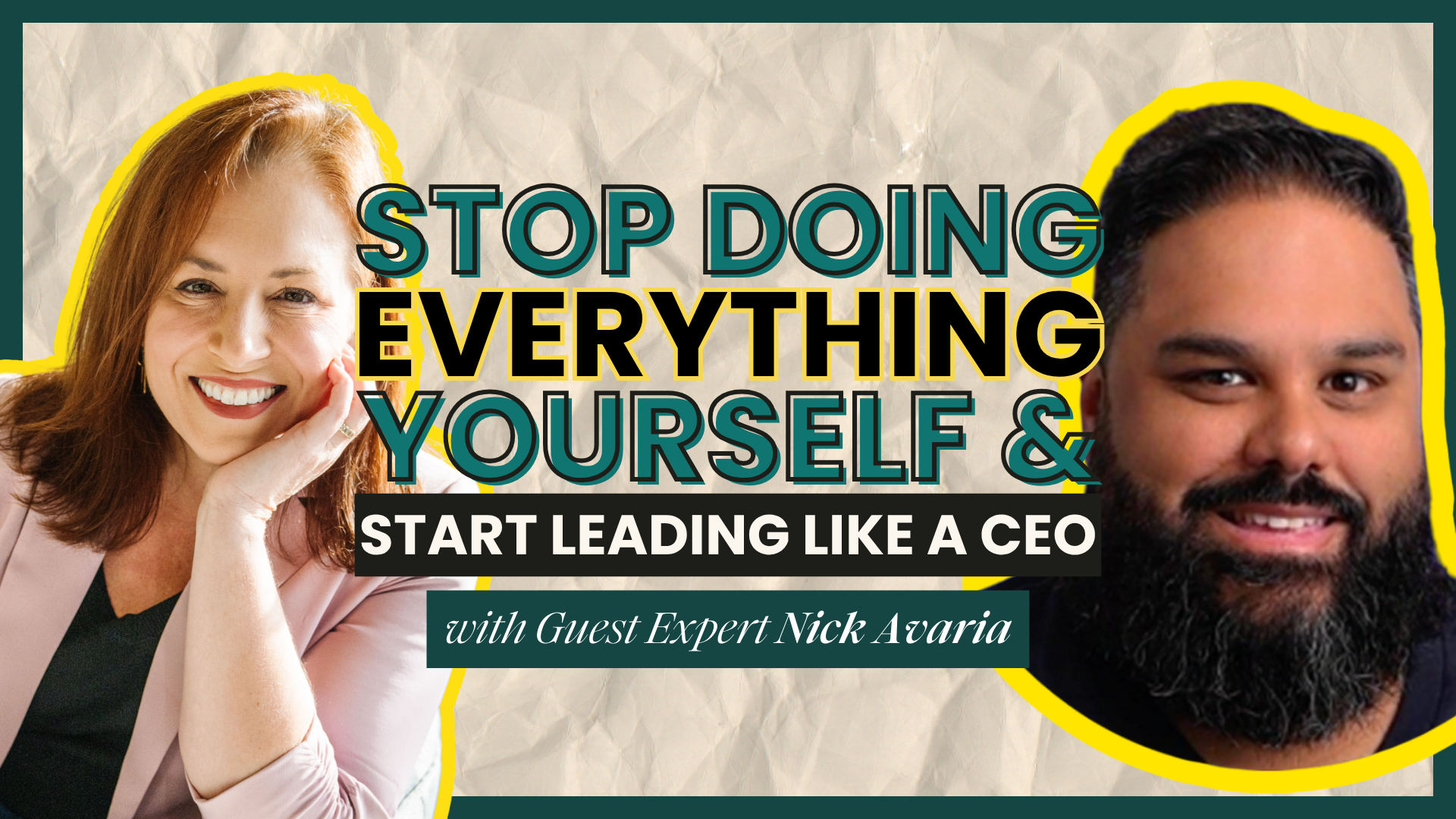
How to Stop Doing Everything Yourself and Start Leading Like a CEO: Expert Insights by Nick Avaria
What happens when your business grows, but you’re still the one doing everything?
For many founders and business leaders, reaching the next stage of growth requires more than working harder. It requires a shift in mindset—from doer to leader, from founder to CEO.
In the latest episode of The Sticky Note Marketing Show, host Mary Czarnecki sits down with Nick Avaria, a serial agency owner and strategist who has scaled multiple marketing agencies beyond seven and eight figures and bought and sold seven firms.
Nick shares practical insights on how leaders can delegate more effectively, build scalable systems, develop talent, and create the space needed to lead rather than constantly firefight.
Here are some of the biggest lessons from their conversation.
“Slow is smooth and smooth is fast.”
The Founder-to-CEO Shift Starts With Letting Go
Nick describes the founder-to-CEO journey as similar to the progression from employee to manager and eventually to executive leadership.
At a certain point, the role changes. Instead of spending most of your time doing the work, solving small problems, approving decisions, and handling daily emergencies, your focus needs to shift toward strategy, people, systems, and the future of the organization.
One of the first signs that you're still operating as a doer is spending roughly 80% of your time on execution and problem-solving.
The challenge is that letting go can feel uncomfortable.
As Nick explains, many founders fall into the mindset of being the superhero: “Only I can solve it.” But the reality is that other people can learn to do the work too—especially when leaders take the time to teach them.
The goal isn't to simply hand off responsibilities and hope for the best. It's to delegate successfully.
Delegation Requires Systems, Training, and Trust
One of Nick's most practical recommendations is using a RACI matrix to clarify responsibilities.
RACI stands for:
Responsible — Who does the work?
Accountable — Who ultimately owns the outcome?
Consulted — Who provides input?
Informed — Who needs to know what's happening?
When founders initially try to delegate, they may still hold both responsibility and accountability. Over time, the person being trained can take on more ownership as they demonstrate their ability to perform the work consistently.
This process should be supported by standard operating procedures (SOPs).
Nick also recommends recording videos of processes so employees can see how a task is performed rather than relying solely on written instructions.
Then comes follow-up: one-on-ones, spot checks, and gradually reducing oversight as the employee demonstrates consistency.
It may feel boring and time-consuming—but that's precisely what creates the freedom to step away from the work.
“It’s Easier If I Just Do It” Can Keep You Stuck
One of the most relatable challenges for business owners is the thought:
“It’s just easier if I do it myself.”
Nick agrees that, in the short term, it often is easier.
But if you're repeatedly doing the same task, the time investment required to train someone else can eventually pay for itself.
For example, if a task takes three hours every week, that's roughly 150 hours a year. Standardizing that process and handing it off can free up significant time that can then be reinvested into more training, documentation, and delegation.
The process happens one brick at a time.
As more responsibilities are successfully delegated, the leader can spend more time building the organization, developing people, and finding capable talent.
Becoming a Better Leader Means Becoming a Better Trainer
Another major theme of the conversation is talent.
Nick challenges the familiar statement:
“There’s no good talent out there.”
His response is to ask whether there is truly no good talent—or whether good talent simply doesn't want to work for that particular leader or organization.
He also points out that leaders may struggle to recognize talent because they haven't had enough experience training people.
Training forces leaders to break a process down into its individual components. Through repeated training, they begin to recognize how different people think, learn, and perform.
That experience can then improve the hiring process.
Instead of relying on whether someone simply “gives you a good vibe,” leaders develop a clearer understanding of the behaviors and characteristics they are looking for.
For Nick, part of becoming an effective CEO is being able to reverse-engineer your zone of genius and teach it to others.
If someone else can eventually perform the work at around 90% of your level, that creates an opportunity for you to move further into leadership.
Great Leaders Need to Know Their Blind Spots
Nick also emphasizes the importance of self-reflection.
As leaders move into executive roles, they need to become increasingly aware of their own blind spots. One way to do that is to deliberately build a support system around themselves.
Nick credits mentors—including experienced executives and financial leaders—with helping him identify problems and perspectives he might not have recognized on his own.
But mentorship isn't the only source of feedback.
Leaders also need people within their organizations who can help reveal blind spots and provide honest feedback.
The challenge isn't simply collecting advice. It's learning which advice to act on and which advice to set aside based on what the business actually needs.
Executive Leadership Requires Alignment
As leaders move further into executive roles, communication also changes.
Nick distinguishes between the role of an executive and that of a CEO.
Executives need to align with the CEO on the organization's goals and how those goals will be achieved. The CEO, meanwhile, needs to clearly establish the organization's overall strategy so that teams and departments understand where they're going.
Nick recommends creating a consistent operating cadence, including quarterly strategic planning or executive off-sites followed by regular leadership meetings.
The purpose isn't simply to create another presentation or strategy document.
It's to create enough time and space for leaders to align on priorities, establish a critical path, and understand what the strategy means for their teams.
When everyone is aligned, execution becomes easier.
Slow Is Smooth, and Smooth Is Fast
One of Nick's recurring principles is:
“Slow is smooth and smooth is fast.”
Organizations can create significant internal friction when they try to move too quickly without building the systems, processes, and people required to support that growth.
Nick compares this to the temptation to simply do everything yourself.
It works at first.
But eventually, the same approach can become a ceiling.
Rapid growth without the necessary infrastructure can create problems with margins, workload, processes, and team capacity. Nick's argument is that sustainable growth requires organizations to build the foundation that allows them to continue operating effectively as they become larger.
That doesn't mean every business should grow slowly. Nick acknowledges that there are situations where speed is essential. His point is that the growth strategy needs to match the organization's circumstances and capacity.
Business Growth Is Also About People
Toward the end of the conversation, Nick shares the personal mission behind his work.
For him, business isn't only about profit or growth. A scalable, profitable business can also create opportunities for employees to be better compensated and have better lives.
He describes his work as “sending the elevator back down” by teaching and training other business owners how to build scalable organizations.
That perspective brings the conversation full circle.
Moving from founder to CEO isn't simply about getting yourself out of the day-to-day work. It's about creating an organization where people, systems, and leadership can work together effectively.
Start With One Brick at a Time
Nick's final advice is highly practical:
Get tactical. Get started.
Build the RACI.
Create the SOP.
Record the process.
Train someone.
Delegate the work.
Then repeat.
The transition from doer to CEO doesn't happen overnight. It happens through the consistent development of systems, people, and leadership habits that allow the organization to operate without depending on one person for every decision.
And sometimes, the work that feels the most boring is exactly what creates the biggest unlock.
Listen to the Full Episode
Want to hear the full conversation between Mary Czarnecki and Nick Avaria?
🎧 Listen to the latest episode of The Sticky Note Marketing Show for more insights on delegation, leadership, talent development, executive thinking, and building a scalable business.
What part of your business are you still doing yourself that could be documented, trained, and delegated?